Wesley Dodds, Pt. 4 (The Sandman)
Soon after he began having nightmares, Wesley Dodds built a laboratory in his basement and developed a formula for sedatives and hypnotic gases.
An encounter with his old friend, Lee Travis, got him thinking about what he was doing with his life as a playboy.
–but what if a man did want to “shun the limelight,” and still do something worthwhile?
He decided to don a suit, hat, opera cape, and… gas mask… to become…
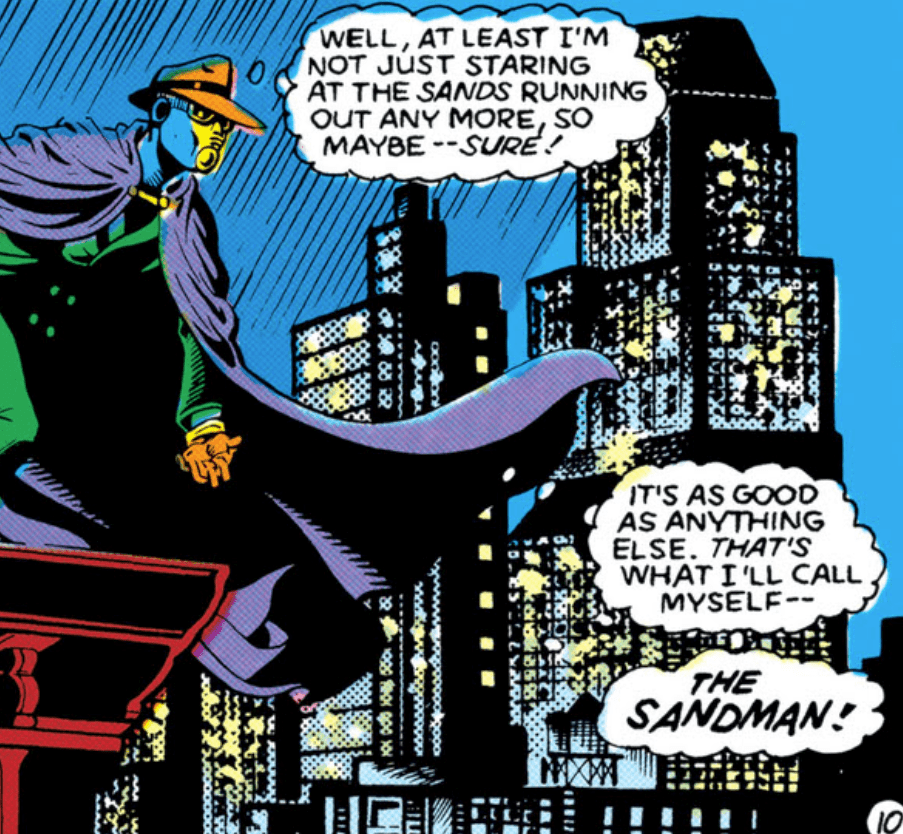
…and was compelled to pursue the most violent of criminals from his dreams.
1939 World’s Fair
Wesley Dodds didn’t know at the time that Lee Travis was the Crimson Avenger. Together, they stopped a plot by “the Phantom of the Fair” to use a voice-controlled robot, Elektro, to attack the visiting King and Queen of England. (This was after Dodds thought “the Crimson” was working with the Phantom and the two crimefighters fought each other.)
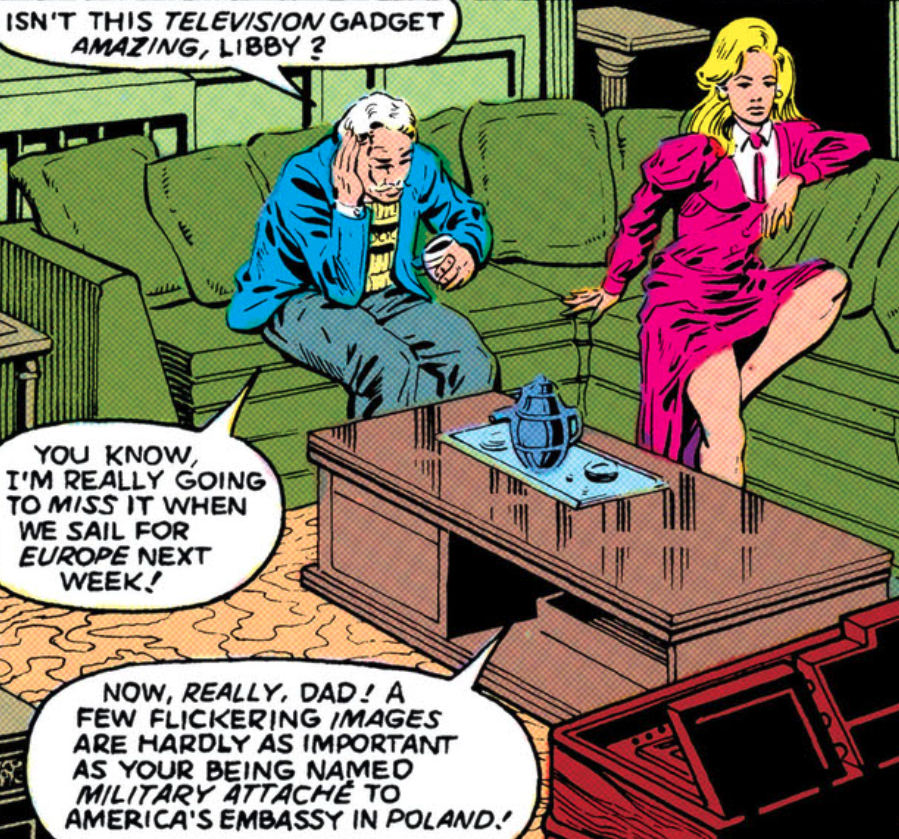
During the World’s Fair, several soon-to-be-familiar names were watching on a new device: the television. Libby Lawrence was with her father, preparing for a trip to Poland:
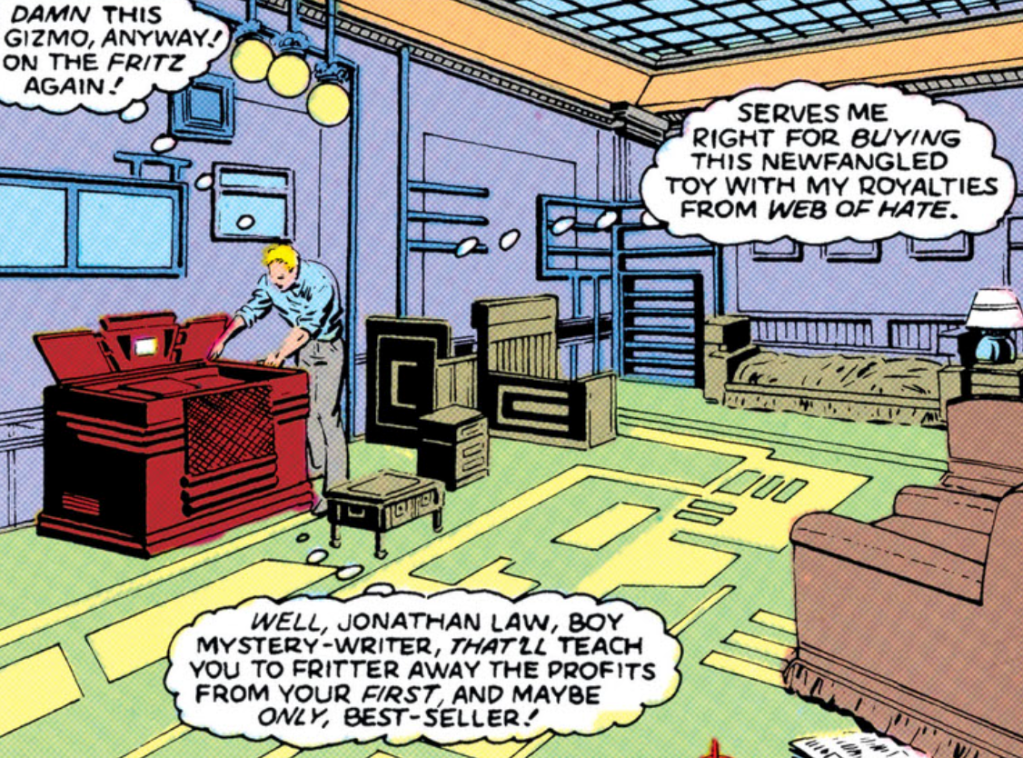
Crime writer Jonathan Law was trying to get his television to work:
Ted Knight, Opal City playboy that preferred to devote his time to science rather than parties, dismissed the new invention:
I doubt this television thing will ever catch on, till they figure out a way the picture doesn’t have to be reflected upward from below. Besides, it’s so expensive… it may be decades before it’s affordable for the masses.
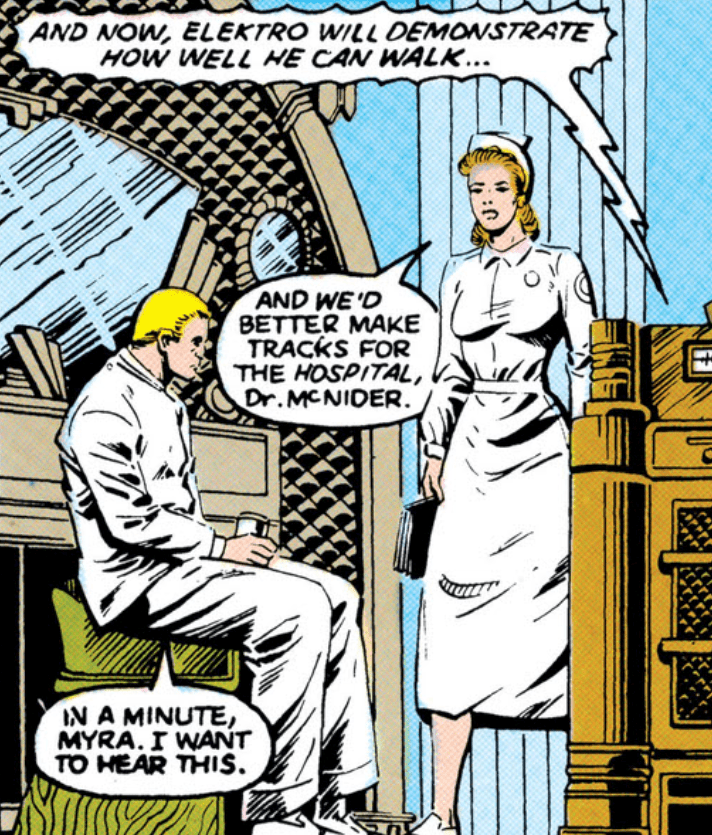
And blind physician, Charles McNider, and his nurse, Myra Mason, watched Elektro’s debut:
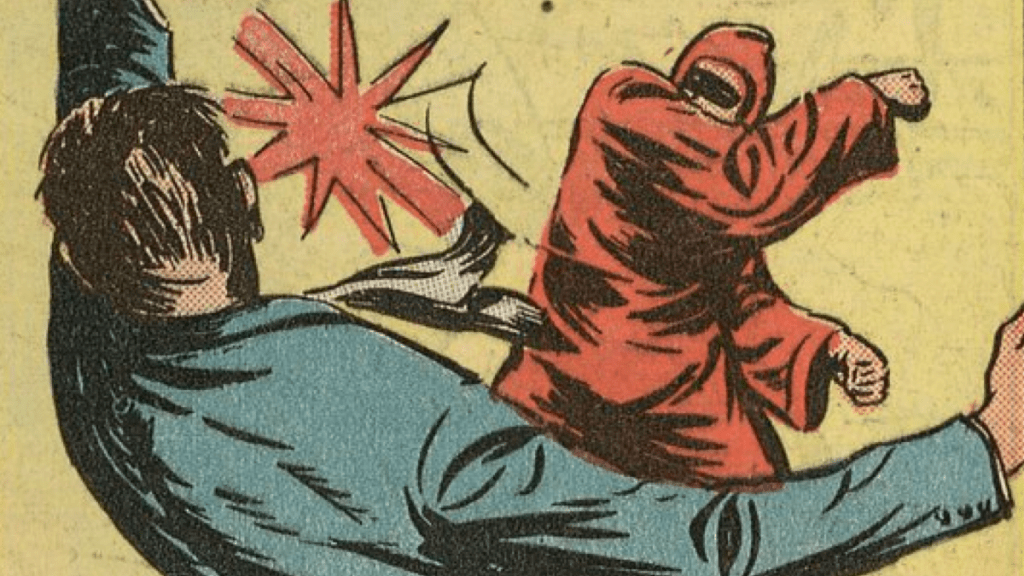
Kent Thurston (Invisible Hood)
Former private detective Kent Thurston was sitting at home reading the newspaper when he received a call from Inspector Bill Blake.
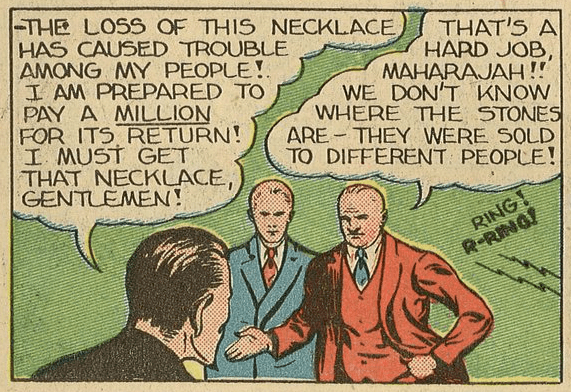
Thurston investigated the case, wearing a red cloak and mask as the Invisible Hood.
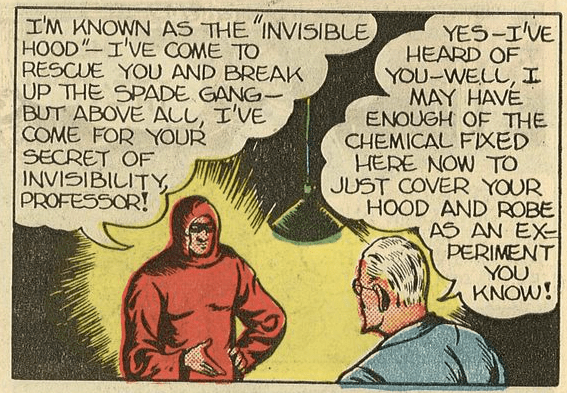
During his next case, he attempted to rescue a kidnapped scientist. The scientist died, but not before he entrusted the secret of invisibility to Kent, allowing him to truly become the “Invisible Hood.”
Jay Garrick (The Flash)
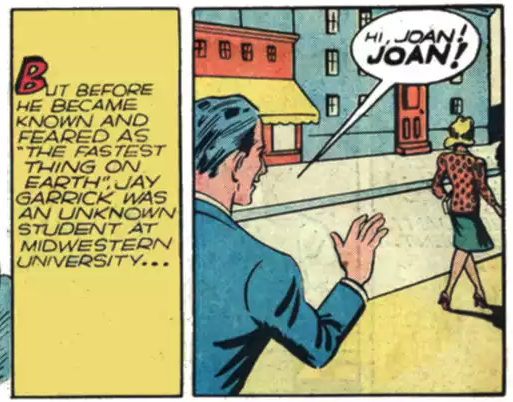
Joan Williams would have nothing to do with Jay Garrick because a man of his build and brains could have been a football star, but instead was a “scrub” who wouldn’t put his mind to football.
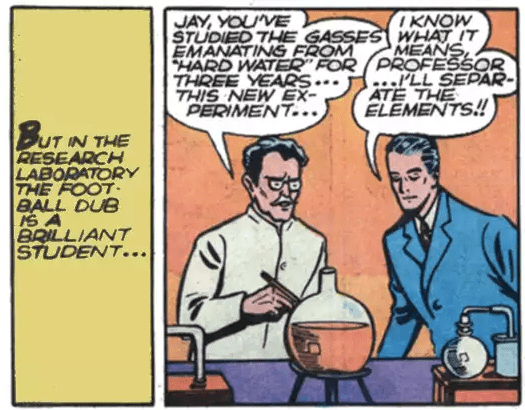
An accident in the lab caused Jay to be exposed to deadly fumes from the gas elements of “hard water.” While recovering in the hospital…
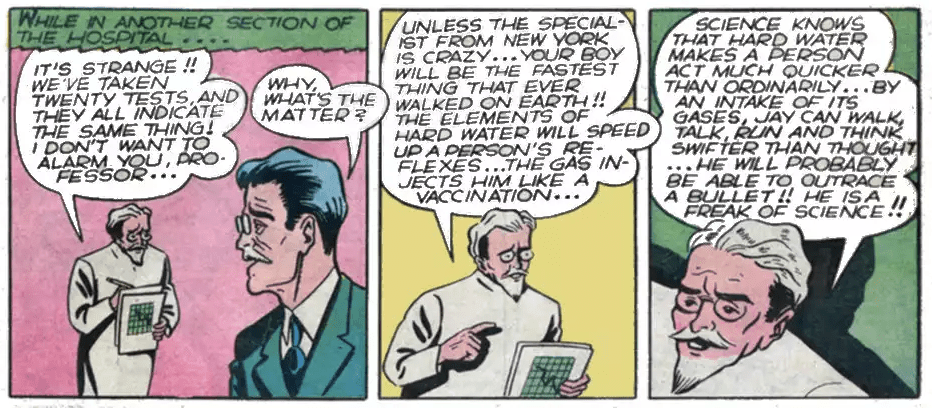
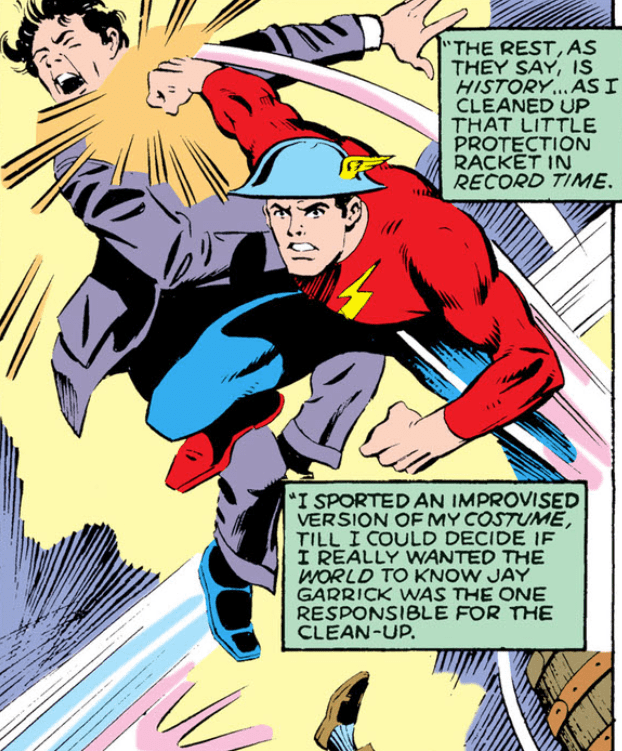
Sure enough, Jay discovered he had been given superhuman speed. He shared his secret with Joan and decided…
If this speed of mine lasts, I’ve got to use it for something more worthwhile than winning football games!
One evening, while reading the Philadelphia Courier, he learned the city was in the grip of a crimewave.
Dan Garrett (The Blue Beetle)
Since we last discussed the Scarab of Kha-Ef-Re, which was left buried with the ancient Egyptian pharaoh and sorcerer, we’ve learned more about its origin…
It was one of many scarabs created by an alien race of conquerors from Space Sector 2 called, the Reach, and spread throughout the galaxy. Originally intended as biological weapons that would infiltrate planets and act in the Reach’s service, the one that arrived on Earth was inadvertently imbued with magical power.
Over 4,000 years later, in August of 1939, archaeologist Dan Garrett and his companion, Professor Luri Hoshid, discovered Kha-Ef-Re’s tomb…
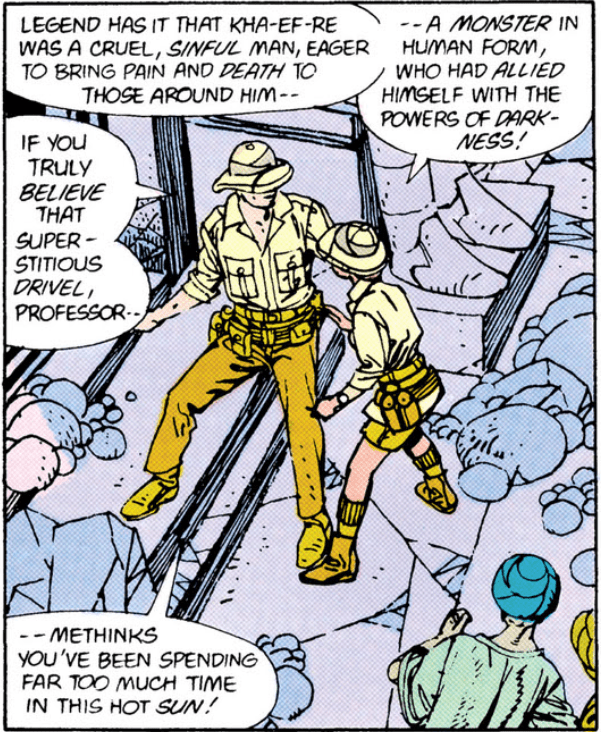
Inside, he found what he was looking for: the sealed sarcophagus of Kha-Ef-Re, lying upon an ancient sacrificial altar still stained with the blood of its victims. On the mummy’s chest, he saw…
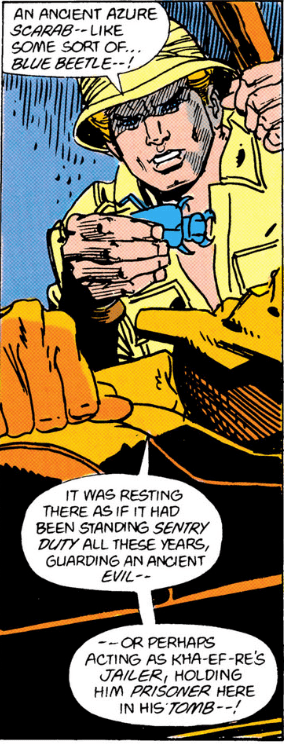
As he touched it, the chamber began to shimmer and blur and, as if in a dream, he was in the presence of “one far more like a god than a man.”
Behold me, man of the future – and heed my words! The power of our sacred scarab has brought you here before us that you might receive a most wondrous gift –! You are a man of courage and honor, Daniel Garrett – and the spinning fates have chosen you as the champion of all mankind! Go ye forth and do battle against the forces of evil wherever you may find them—for when you speak the holy words, yours shall be the power to banish evil from the earth for all time –
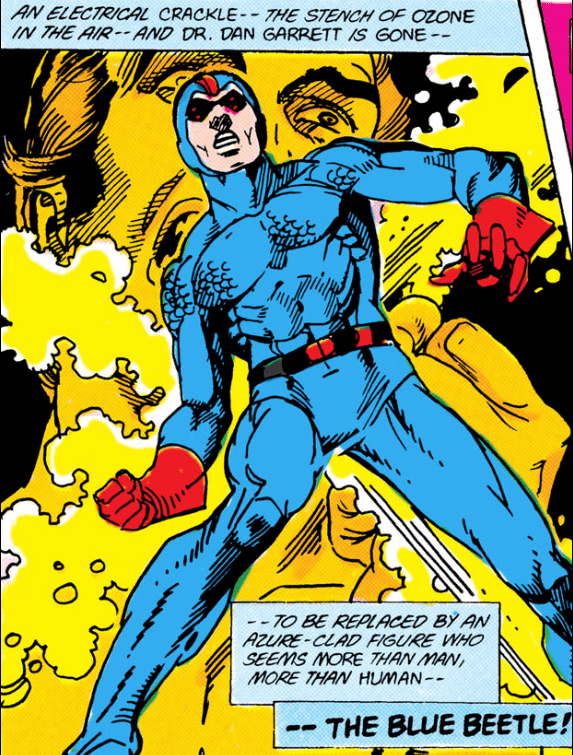
In the months that followed, the Blue Beetle proved as good as his word – defending the world as one of the so -called “mystery men” of the late 1930s and 1940s.
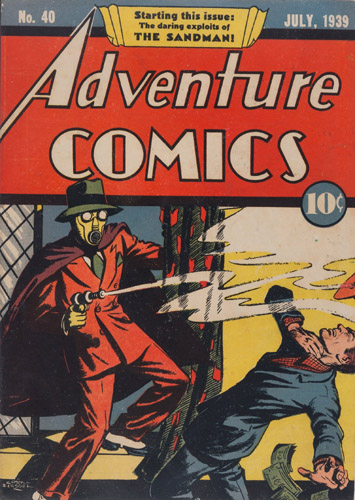
Adventure Comics #40
July 1939 (June 15, 1939)
$0.10
Sandman
“The Tarantula Strikes”
6 pages
Writer: Gardner F. Fox
Artist: Bert Christman
Editor: Vincent A. Sullivan
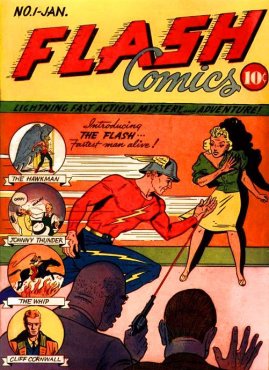
Flash Comics #1
Jan. 1940 (Nov. 10, 1939)
$0.10
Flash
(Origin of the Flash)
15 pages
Writer: Gardner F. Fox
Artist: Harry Lampert
Editor: Maxwell Charles Gaines
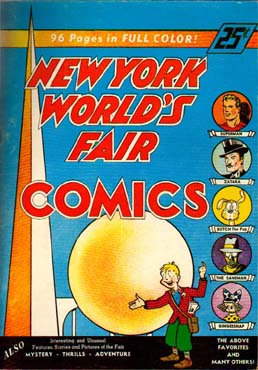
New York World’s Fair Comics #1
1939 (April 30, 19839
$0.25
Sandman
(Sandman at the World’s Fair)
10 pages
Writer: Gardner F. Fox
Artist: Bert Christman
Editor: Vincent A. Sullivan
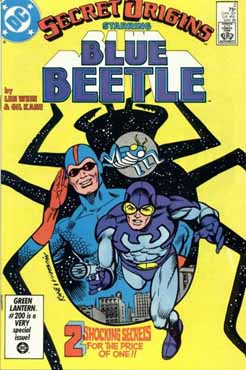
Secret Origins (vol. 2) #2
May 1986 (Feb. 13, 1986)
$0.75
Blue Beetle
“Echoes of Future Past”
23 pages
Writer: Len Wein
Artist: Gil Kane
Editor: Julius Schwartz
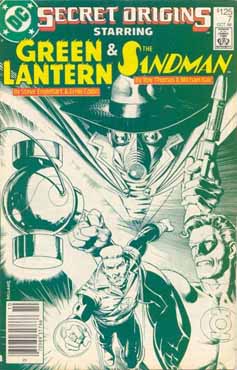
Secret Origins (vol. 2) #7
July 1939 (June 15, 1939)
$0.10
Sandman
“Phantom of the Fair”
22 pages
Writer: Roy Thomas
Plotter: Danette Thomas
Penciller: Michael Bair
Inker: Steve Montano
Editor: Robert Greenberger
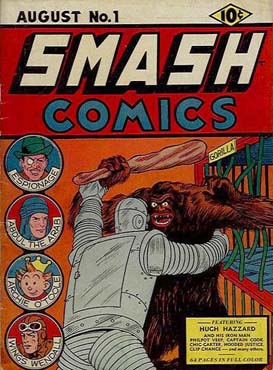
Smash Comics #1
Aug. 1939 (June 16, 1939)
$0.10
Invisible Hood
(Introducing the Invisible Hood)
4 pages
Writer: Arthur A. Pinajian
Artist: Arthur A. Pinajian
Editor: Edward C. Cronin
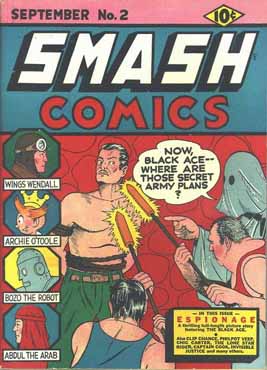
Smash Comics #2
Sept. 1939 (July 19, 1939)
$0.10
Invisible Hood
(No Title)
5 pages
Writer: Arthur A. Pinajian
Artist: Arthur A. Pinajian
Editor: Edward C. Cronin

Sheldon Meyer was an editor for publisher M.C. Gaines at McClure Syndicate and was responsible for sending Superman to DC editor Vin Sullivan as filler material for Action Comics. (He also created a popular comics character, Scribbly.)
The art in early Superman stories was crude; Joe Shuster could not draw well. But the brilliance of the character was not only that he was the first superhero, but that he also introduced the concept of the alter ego: Clark Kent (named after Clark Gable.)
Before Superman, comic book heroes were not very interesting. They were often no match for the villains that were often bigger, stronger, and smarter. Whatever happened to the villains in the final panels of a story, they were better equipped than the sometimes silly heroes. After Superman, the comic book business was booming and imitators flooded newsstands.
No characters had yet been successful enough to warrant their own title, but Superman #1 was distributed on May 18, 1939, containing reprints from Action Comics, as well as original material. Its pages were also used to cross-promote Action Comics, a new Superman newspaper strip, and the “Supermen of America” club.
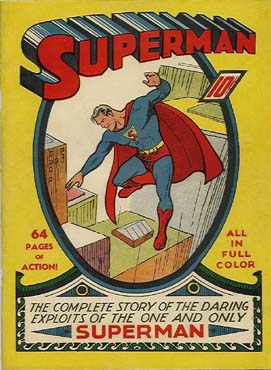
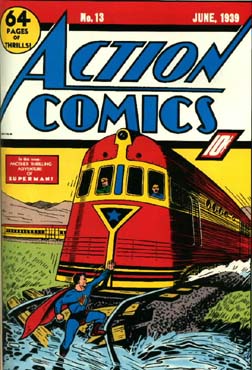
Superman #1 introduced Clark Kent’s adoptive parents, Jonathan and Martha, and the Metropolis newspaper, The Daily Star. In Action Comics #13 (May 2, 1939), Superman took his first flight, graduating from simply leaping tall buildings in a single bound.
In 1939, Jack Liebowitz and M.C. Gaines formed All American Publications, and Sheldon Meyer came with them. By springtime, they had launched three titles: All-American Comics, Movie Comics, and Mutt & Jeff. They apparently maintained a friendly relationship with DC and sometimes shared characters.
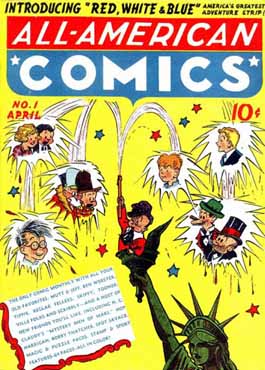
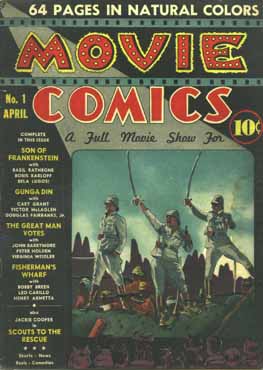
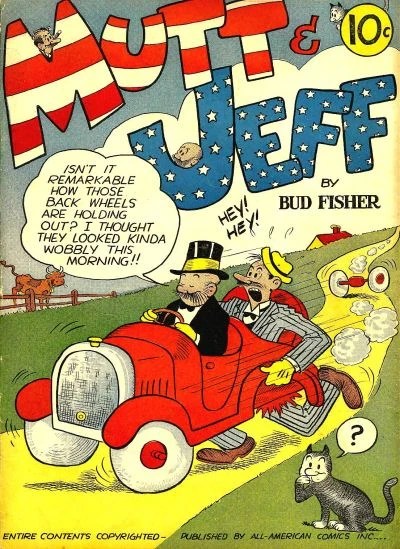
All-American Comics contained newspaper reprints, puzzle pages, and original pages. Strips included Scribbly , Hop Harrigan, and Red, White & Blue.
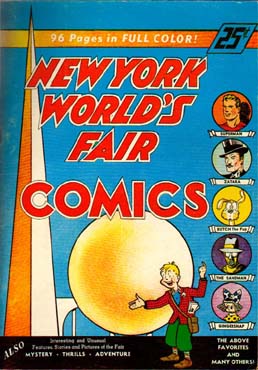
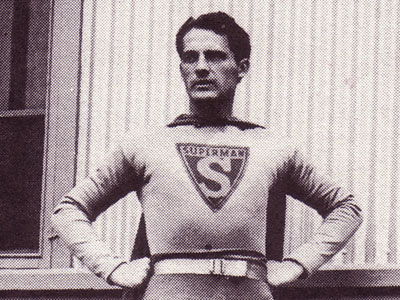
Meanwhile, DC published New York World’s Fair Comics #1 featuring Superman, Slam Bradley, Zatara, Scoop Scanlan, and the first appearance of The Sandman. DC also hired actor Ray Middleton to portray Superman in person at the fair.
 CODEX OMNIVERSA